Glycemic Index (GI) and Glycemic Load (GL) both describe how foods affect blood sugar, but they measure different things. GI is a number (0–100) that ranks foods by how quickly they raise blood glucose compared to pure sugar. A high-GI food (like white bread) spikes blood sugar quickly, while low-GI foods (like lentils) release sugar more slowly. Glycemic Load (GL), however, takes into account how much carbohydrate is eaten. You can think of GI as the speed of a car and GL as the total distance traveled. A sports car (high GI) can go very fast, but if it only drives a short time (small serving), the total distance (GL) is small. A family van (lower GI) that runs longer (larger portion) might cover more miles (higher GL). In fact, GL is calculated as GI × grams of carbohydrate per serving ÷ 100, giving a more realistic picture of real-world blood sugar impact.
The glycemic load (GL) of a food combines its GI with the actual carbohydrates eaten (GL = GI × carbs/100). This image illustrates how GL factors in both the food’s GI and portion size. For example, a large bowl of watermelon (high GI of ~72) has relatively few carbs per serving, so its GL stays low. Conversely, a small portion of candy (moderate GI of ~65) may also have a low GL if the serving is tiny. In short, GL tells you the true effect on blood sugar by including serving size, whereas GI by itself only tells you the rate of sugar release.
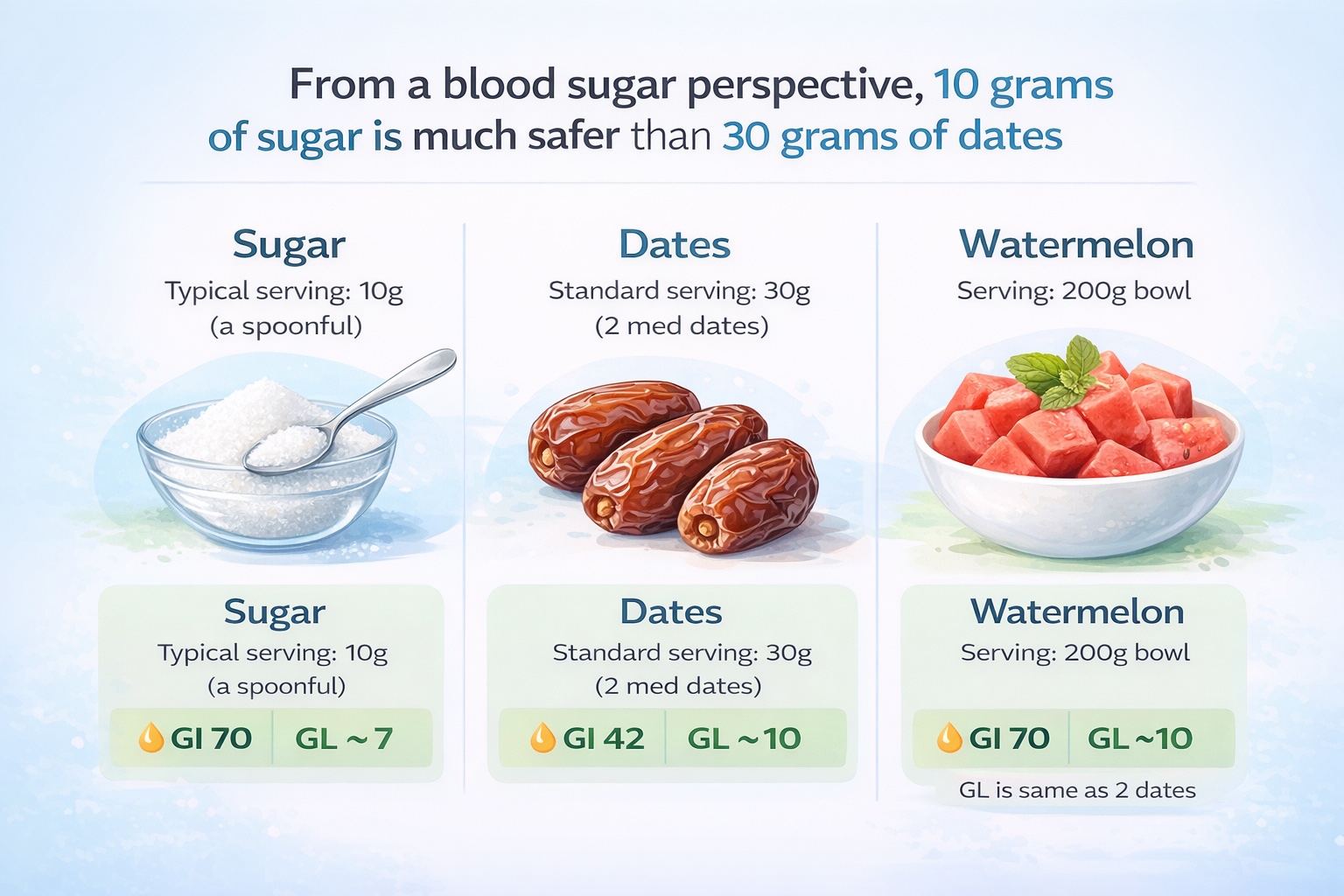
Relying on GI alone can create confusion. For instance, consider sugar, dates, and watermelon:

At first glance, sugar looks “worse” (GI ~65) than watermelon (GI ~72), but the tiny amount of sugar (just 10 g) delivers less total carbohydrate. In fact, its GL is only ~7, whereas a large slice of watermelon or a handful of dates both have GL around 10–12. In other words, sugar spikes fast (high GI) but you usually eat so little that the total glucose load is small, while dates release sugar more slowly but in a bigger dose, and watermelon has lots of water diluting its sugars. Harvard Health explains this: “GI tells just part of the story. … To understand a food’s complete effect on blood sugar, you need to know both how quickly it raises blood glucose and how much glucose per serving it delivers. A separate measure called the glycemic load does both — which gives you a more accurate picture of a food’s real-life impact”. In practice, total carbs in a meal (i.e. GL), not GI alone, is a stronger predictor of your blood sugar response. So eating a small serving of a high-GI food might raise blood sugar less than a large serving of a moderate-GI food.
The table below illustrates GI and GL for various foods (including Indian staples). Notice how serving size and carbs change the picture:

Even though white rice and watermelon share a high GI, notice that a full cup of rice (45 g carbs) gives a GL of ~32 – much higher than the GL from 200 g watermelon (only ~12). Similarly, a whole wheat roti (moderate GI) packs enough carbs to give a higher GL than a bit of table sugar despite sugar’s higher GI. This comparison underscores that portion size and carb count (GL) matter more than GI alone for managing blood sugar.
These analogies illustrate why dietitians stress “what and how much” over just “how fast.” In practice, foods with a low GL (≤10) tend to cause only mild rises in blood sugar. Aiming for reasonable portions of high-GI foods, or balancing them with fiber and protein, keeps your overall GL in check and stabilizes blood sugar.
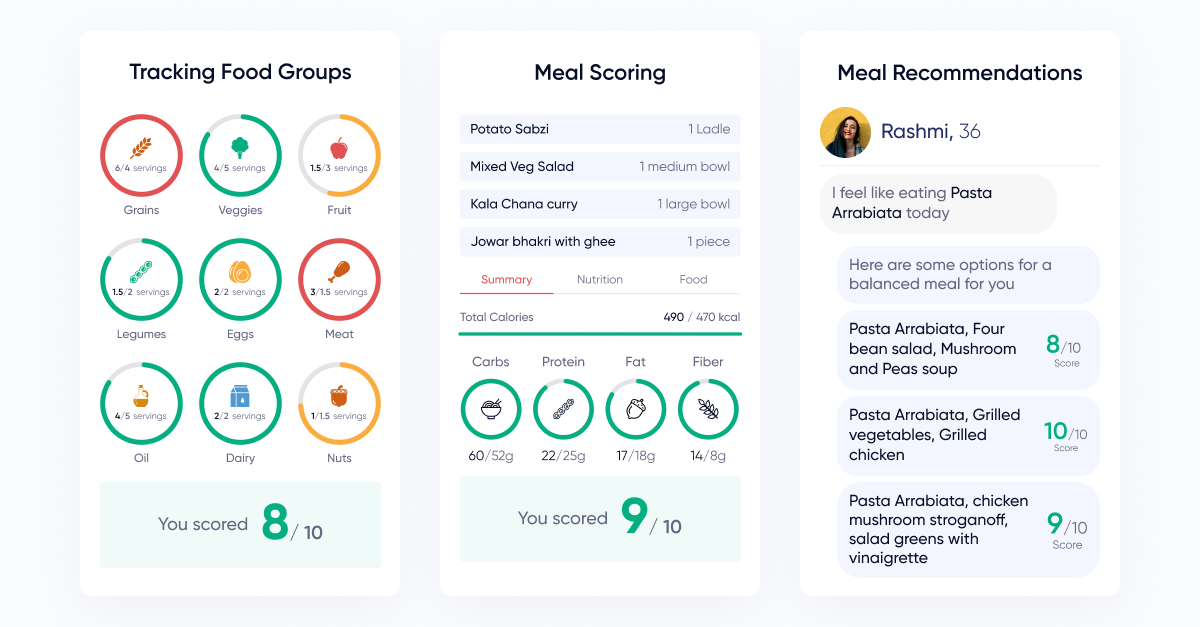
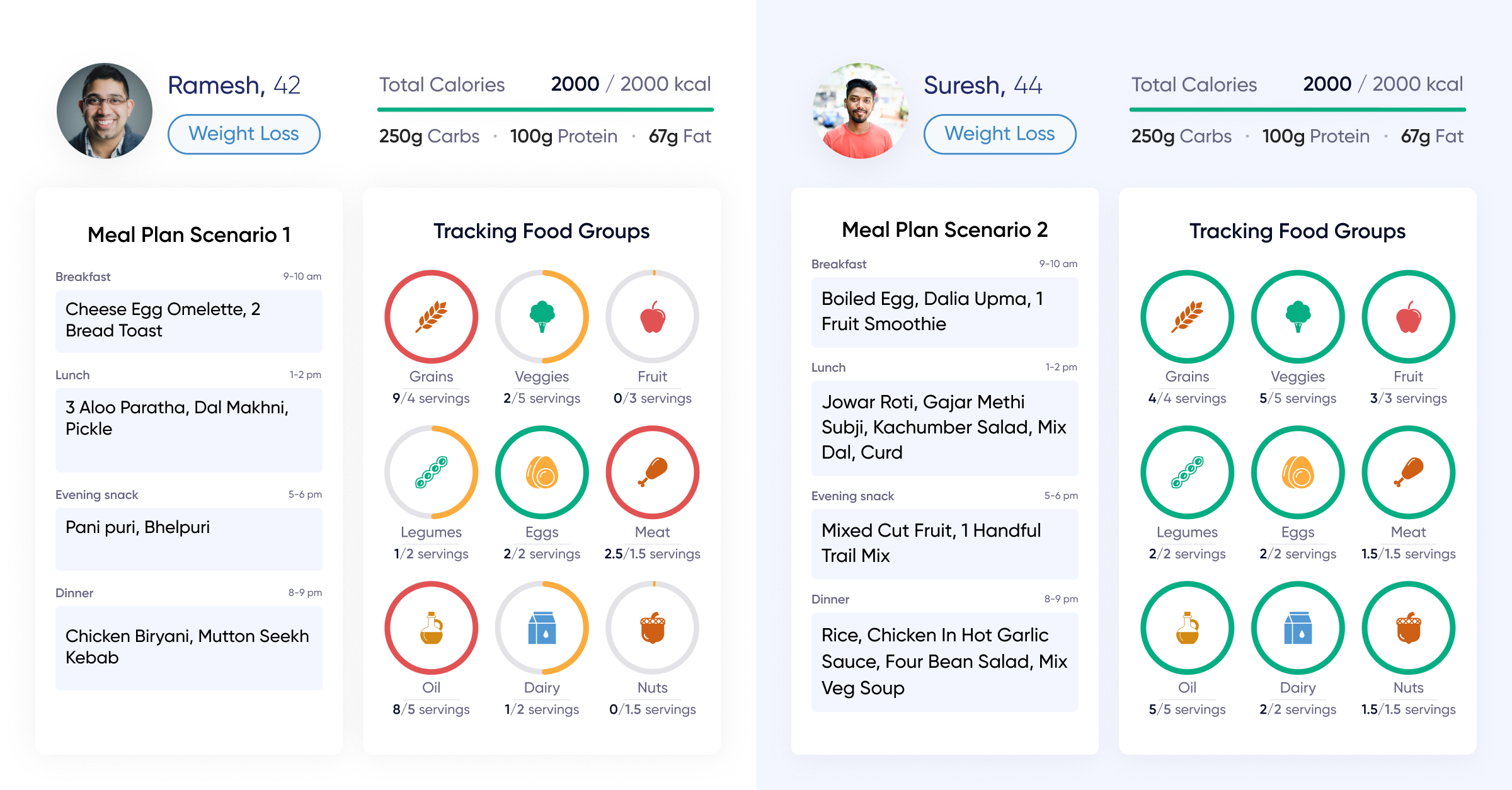
Keeping track of GL for complex Indian meals can be tricky without good data. That’s where Bon Happetee comes in. Bon Happetee’s nutrition database covers thousands of Indian ingredients and recipes – think of it as an “IMDb of Indian foods”. It provides accurate carb counts for classic desi dishes (dal, sabzi, chai, etc.), so you know exactly how many carbs you’re eating in a katori of dal or a roti. Caddy taps into this rich data to guide your meals. Built as a GLP-1 companion for Indians, Caddy helps people on diabetes-friendly or GLP-1-based weight loss plans by making nutrition simple. It lets you log real Indian meals (sabzi, biryani, dosa, paratha…) and calculates the calories, protein and carbs accurately. Caddy’s scoring and guidance focus on portion size and nutritional balance. In essence, Caddy turns all that Bon Happetee data into actionable insights so you don’t have to guess – your GLP-1 plan reflects real Indian meals and portions. In short: don’t be fooled by high or low GI alone. Always consider how much of a food you’re eating. Bon Happetee makes it easy to find carb counts for desi foods, and Caddy uses that information to simplify tracking glycemic load. Together, they put blood sugar awareness at your fingertips.
Managing blood sugar and weight is easier when you focus on glycemic load and total carbs, not just GI. Use the simple rule: small servings of high-GI foods are usually OK, large servings are not. Include fiber, protein, and healthy fats to blunt spikes. And leverage tools like Bon Happetee’s database and Caddy’s tracking app to get accurate carb numbers for every Indian meal. Ready to simplify your diet? Visit Bon Happetee to explore Indian food data and download Caddy to start tracking your meals. With Bon Happetee’s detailed nutrition and Caddy’s GLP-1 guidance, you’ll have the right information to make diabetes-friendly choices and reach your health goals. Sources: Authoritative nutrition experts agree that GL incorporates both GI and carb amount for real-world impact. Harvard Health notes GI alone “doesn’t tell you how high your blood sugar could go” – that’s why GL matters. The values above (GI/GL) come from standard food composition data. Caddy and Bon Happetee leverage this science to help you eat smarter every day.