We live in a world where nutrition data is everywhere — from calorie trackers to influencer videos claiming to expose “unhealthy” foods.
But as accurate as numbers might seem, data without context can easily mislead.
Recently, a popular health influencer compared 100g of boiled potatoes, French fries, and chips, showing how the calories jumped dramatically — from 80 kcal to 300 kcal to 500 kcal.
Technically correct.
Practically? Misleading.
Welcome to what we call “standardized confusion” — when standardized nutrition data is used without considering how food is actually consumed.
For more than 100 years, nutrition databases have presented values per 100g — a format meant for consistency, not daily guidance.
It’s a valuable reference for scientists and app developers, but not how real people eat.
Let’s be honest — nobody eats:
So, when you compare foods purely on a 100g basis, you’re comparing data, not diets.
To truly understand the role of food in your diet, you must look at portion size — the amount you actually eat in one sitting.
Here’s what that looks like in the real world:
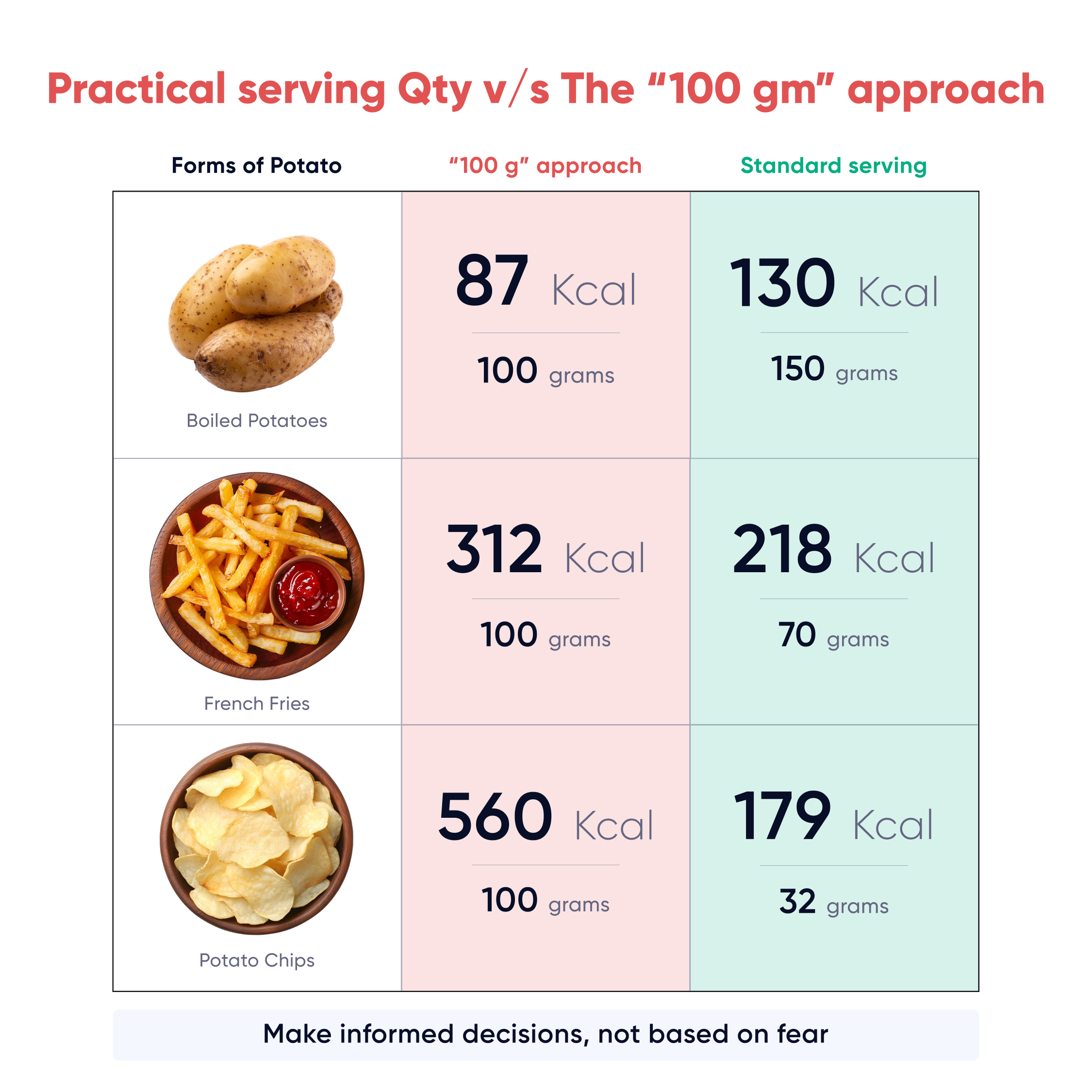
Now the “evil fries” don’t seem so bad, right?
When viewed through a realistic portion lens, each of these foods fits into a balanced diet — when consumed mindfully.
Data is a powerful tool — it can either educate or intimidate.
Misleading use of nutrition data creates fear.
Smart use of data builds understanding.
At its best, nutrition data helps people make informed food choices, not guilt-driven ones. It should empower you to eat better — not restrict you unnecessarily.
Let’s take the French fries example again.
Eaten alone, they’re high in carbs and fat. But consumed in moderation, as the primary carb source of your meal, and paired with protein and fiber-rich vegetables, they become part of a nutritionally balanced meal.
Example of a balanced plate:
That’s not junk food — that’s a well-designed, satisfying meal that checks all your macronutrient boxes.
Interestingly, this approach isn’t new. Many traditional restaurant meals naturally follow this structure — pairing meats or mains with salad and a side of potato in various forms. It’s balance by design, not by accident.
Food isn’t inherently “good” or “bad.”
It’s context — portion, frequency, and combination — that defines its role in your diet.
So, next time you see a viral post demonizing a food based on “100g data,” pause and think:
Because smart use of nutrition data educates, while lazy use misleads.
The data doesn’t lie — but it needs the right storyteller.